
R-LABSHealthcare + Housing Innovation Cluster
← All missions

Regenerative Living Solution

No one should be discharged into homelessness.

Mission 11: Flexible supportive housing to house the homeless and create ER capacity

Stage: ExploringFeatured mission | Replication opportunity under exploration

Explore how a hospital, housing provider, municipality, and community-services coalition could adapt and replicate supportive housing approaches for people experiencing homelessness and complex health needs.

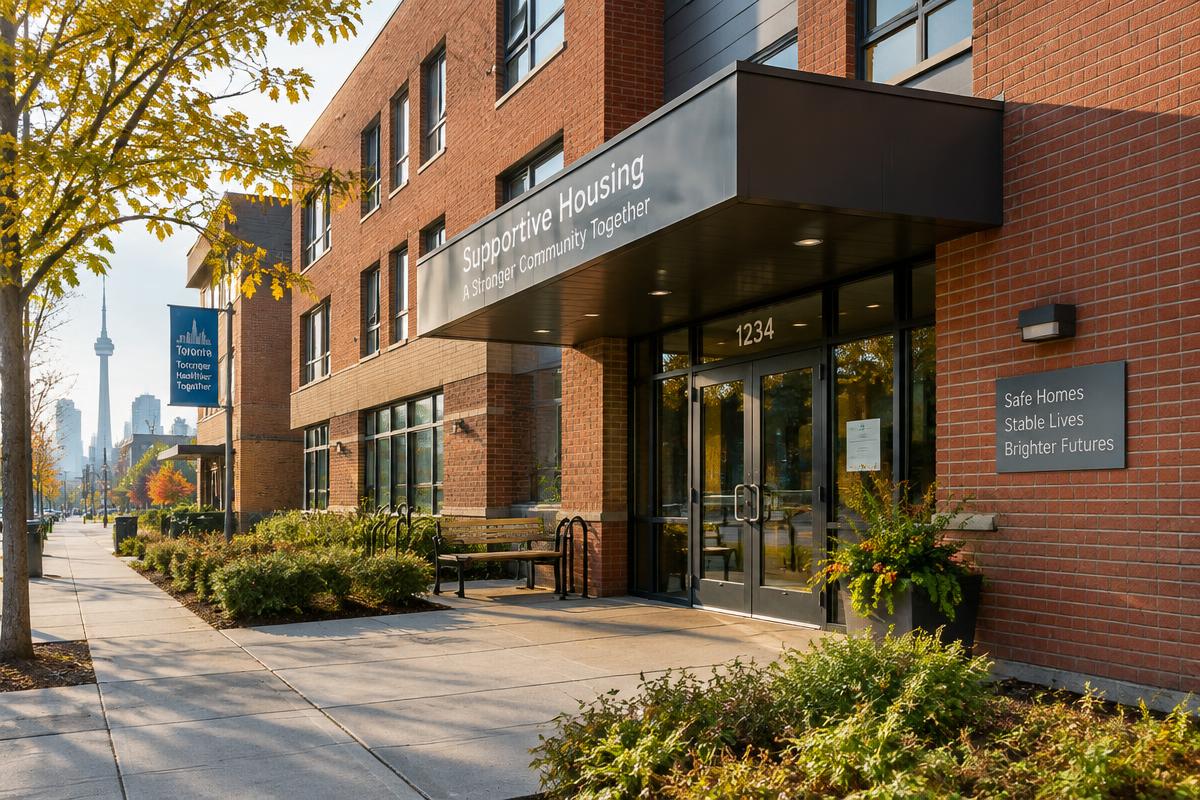
Flexible supportive housing to house the homeless and create ER capacity illustrative image

Replication opportunity under exploration. R-LABS does not claim ownership of the Dunn House model or its intellectual property. Any adaptation or replication must involve the relevant originating organizations and respect their permissions, expertise, and experience.

Evidence · as reported by the original partners

What Dunn House reported in its first year

These are results reported for the original Dunn House initiative in Toronto. They are not a guarantee of equivalent results at another site.

52%

reduction in emergency department visits

Reported · first year

79%

reduction in hospital bed days

Reported · first year

51

supportive and affordable homes

Reported · first year

~$2M

reported healthcare cost savings

Reported · first year

Sources

Links currently point to partners’ public news pages; specific reports and dates are to be confirmed.

The challenge

People with complex health needs are discharged to unstable or unsafe living situations.

Who experiences it

People experiencing homelessness with complex health needs, and the hospitals that treat them.

Why current systems fall short

Hospitals cannot provide housing, and housing programs are not designed around discharge timelines.

Why it crosses sectors

Stable outcomes require housing, health care, social services, and public funding together.

If it stays unresolved

Repeated emergency visits, long hospital stays, and continued homelessness.

The opportunity

Adapt a supportive housing approach with wraparound support, in partnership with originating organizations.

What is already known

Supportive housing combines stable homes with on-site supports.

Demonstrated elsewhere

Dunn House in Toronto has publicly reported first-year results (see evidence).

What R-LABS proposes to test

Explore, with originating partners, whether and how the approach could be adapted elsewhere.

What still requires validation

Permissions, local need, site, operating model, and funding (To be validated).

The coalition

Who needs to be at the table

Roles are proposed. No organization is implied to have agreed to participate. Select “This could be us” on any role to carry it into the participation form.

Hospital or health system

Proposed role
Why it matters
Health systems see the downstream cost of unstable housing and fragmented care first.
Could contribute
Clinical sponsorship, cohort definition, referral pathway, and potential health-service contributions.
Could gain
A tested discharge pathway for patients who frequently return to hospital.
Next practical step
Nominate a sponsor to join a 60-minute problem-definition session.

Municipalities and public agencies

Proposed role
Why it matters
Municipalities shape land use, approvals, housing programs, and community services.
Could contribute
Planning data, policy alignment, potential land or program levers, and approval navigation.
Could gain
Evidence for planning decisions and a coordinated route to housing and health targets.
Next practical step
Identify a planning or housing lead to review the mission brief.

Supportive housing operator

Proposed role
Why it matters
Operators turn buildings into stable homes and know what support models are sustainable.
Could contribute
Tenancy management, on-site support model, and operating cost realism.
Could gain
Partnership with health and public funders on a defined model.
Next practical step
Share non-confidential portfolio context and operating constraints.

Housing owner, developer, or construction partner

Proposed role
Why it matters
Physical delivery needs design, construction, and cost discipline from the start.
Could contribute
Site analysis, design concepts, cost estimates, and delivery methods.
Could gain
Early positioning on mission-aligned projects with clearer demand and partners.
Next practical step
Propose a candidate site or delivery approach for preliminary review.

Capital and funding partners

Proposed role
Why it matters
Missions need patient, blended capital that matches risk to the stage of evidence.
Could contribute
Capital grants, philanthropic contributions, and feasibility funding.
Could gain
Early visibility into a curated, evidence-led pipeline.
Next practical step
Indicate the stage and type of capital you could explore.

Research and evaluation partners

Proposed role
Why it matters
Independent evaluation separates what works from what simply sounds good.
Could contribute
Evaluation design, baseline methods, literature review, and outcome measurement.
Could gain
Applied research partnerships and access to real-world implementation settings.
Next practical step
Propose an evaluation approach or relevant prior work.

Community organizations

Proposed role
Why it matters
Community organizations hold trust, local knowledge, and service delivery capacity.
Could contribute
Wraparound services: mental health, addiction, and social supports.
Could gain
A recognised role and resourcing within a coordinated model.
Next practical step
Share the services and populations you currently support.

People with lived experience

Proposed role
Why it matters
Solutions designed without the people affected rarely work as intended.
Could contribute
Insight into barriers, design feedback, and participation in governance.
Could gain
Meaningful, compensated input into decisions that affect your community.
Next practical step
Express interest in an advisory conversation.

Select one or more roles above

Continue to participation →

First proof of value

A 90-day discovery and feasibility process ending in a go / no-go recommendation.

Proposed plan, not a guaranteed schedule
  1. 1

    Define the problem and target population

  2. 2

    Identify the host organization and local context

  3. 3

    Assemble the minimum viable coalition

  4. 4

    Establish a baseline and evidence plan

  5. 5

    Design and cost a bounded pilot

  6. 6

    Agree on a go / no-go decision

Days 1–30 · Model discovery

  • Initiate dialogue with relevant originating partners.
  • Understand the operating model, lessons learned, evidence, and permissions.
  • Identify a prospective host community and healthcare sponsor.

Days 31–60 · Local feasibility

  • Define the target population and local need.
  • Assess potential sites and delivery approaches.
  • Develop preliminary capital and operating assumptions.
  • Identify potential public, philanthropic, and healthcare funding sources.

Days 61–90 · Replication decision

  • Confirm potential host, operator, and coalition roles.
  • Develop a preliminary implementation and evaluation blueprint.
  • Determine whether there is a credible path to funded implementation.
  • Produce a documented go / no-go recommendation.
Proposed scope
A proposed 90-day discovery and feasibility process. Not a commitment to launch a housing project in that period.
Required participants
  • Originating partners (to be engaged)
  • Prospective hospital sponsor
  • Supportive housing operator
  • Municipality
  • Evaluation partner
Key assumptions
  • Originating partners are willing to share learning
  • A host community has a defined need
  • Capital and operating funding can be identified
Data or evidence needed
  • Original reported outcomes
  • Local need and cohort size
  • Site options
  • Funding sources
Deliverables
  • Implementation and evaluation blueprint
  • Preliminary capital and operating plan
  • Go / no-go recommendation
Indicative timeframe
Proposed: 90-day planning horizon
Success measures
  • Host, operator, and coalition roles confirmed
  • Credible path to funded implementation identified
Decision gate
Replicate only when permissions, funding, capacity, and evidence support doing so.

Economics explorer

Test the assumptions

Every input is an editable, illustrative assumption, not verified project data. Replace with local information as it becomes available.
Illustrative assumptions only
Capital
Annual operations + support
System value (shown separately)

Total capital cost

$20,000,000

Capital funding gap

$10,000,000

Annual operating + support cost

$2,000,000

Annual operating revenue and contributions

$285,000

Annual operating funding gap

$1,715,000

Potential system value (not netted against gaps)

$0

Healthcare savings do not automatically fund housing operations and may not accrue to the same payer. System value is shown separately and is not cash savings to any organization.

Moonshot

No one should be discharged into homelessness

Every region has a coordinated pathway from hospital to stable, supported housing.

Target requires coalition agreement.

Could your community be the next place where housing becomes part of the care solution?

All forms prohibit patient-identifiable information and confidential clinical data.