
R-LABSHealthcare + Housing Innovation Cluster
← All missions

Mission 8 · Regenerative Living Solution

Care House

Stage: Exploring

Help older adults adapt their homes for accessibility, safety, and aging in place by coordinating assessment, financing, grants, trusted contractors, and relevant technology.

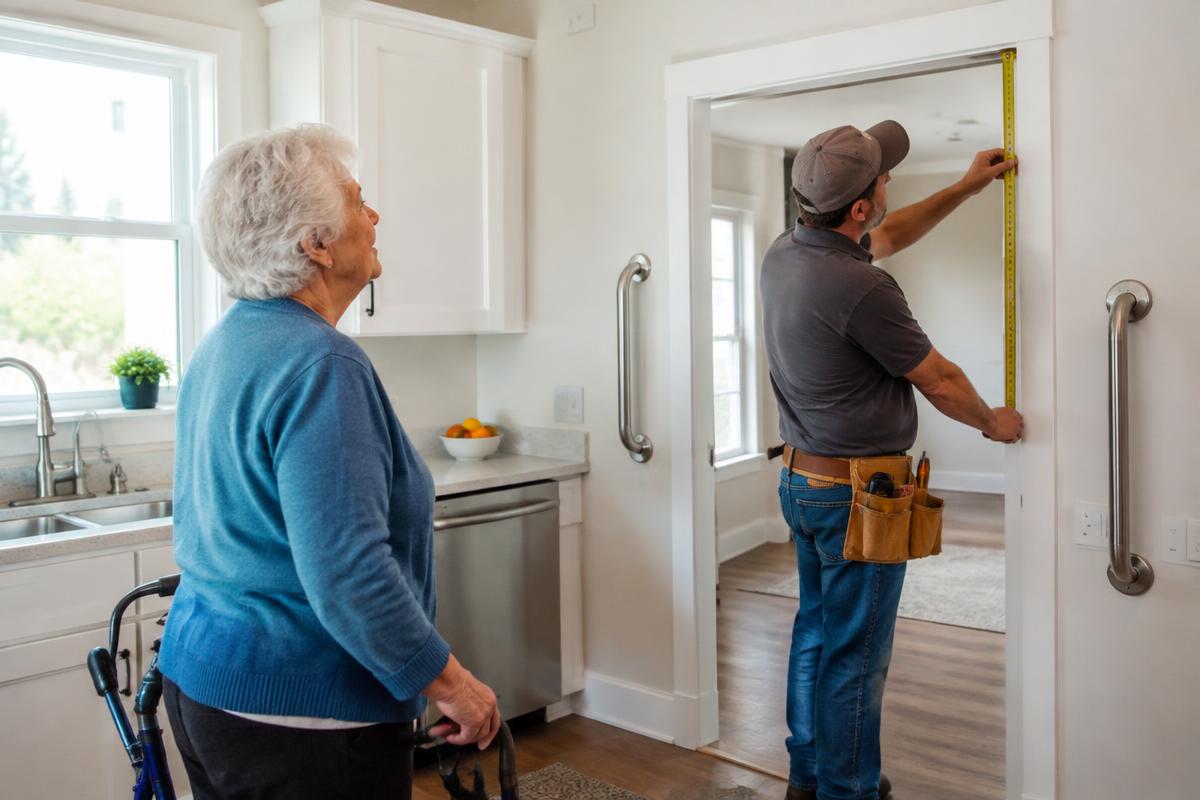
Care House illustrative image

The challenge

Home adaptation is confusing, fragmented, and often left until after a fall or hospital stay.

Who experiences it

Older adults and their caregivers.

Why current systems fall short

Assessment, funding, and contractors are disconnected.

Why it crosses sectors

Health, housing programs, and trades rarely coordinate.

If it stays unresolved

Preventable falls and early moves out of home.

The opportunity

One coordinated pathway from assessment to completed adaptation.

What is already known

Home modifications can reduce fall risk.

Demonstrated elsewhere

Coordinated home-modification programs exist.

What R-LABS proposes to test

Test a single coordinated pathway.

What still requires validation

Uptake, cost, and funding mix (To be validated).

The coalition

Who needs to be at the table

Roles are proposed. No organization is implied to have agreed to participate. Select “This could be us” on any role to carry it into the participation form.

Healthcare systems

Proposed role
Why it matters
Health systems see the downstream cost of unstable housing and fragmented care first.
Could contribute
Clinical leadership, a defined patient cohort definition, operational insight, and a pilot host setting.
Could gain
A tested pathway that may improve patient flow and outcomes, with shared evaluation.
Next practical step
Nominate a sponsor to join a 60-minute problem-definition session.

Community organizations

Proposed role
Why it matters
Community organizations hold trust, local knowledge, and service delivery capacity.
Could contribute
Wraparound services, outreach, local insight, and community engagement.
Could gain
A recognised role and resourcing within a coordinated model.
Next practical step
Share the services and populations you currently support.

Developers, builders, and architects

Proposed role
Why it matters
Physical delivery needs design, construction, and cost discipline from the start.
Could contribute
Site analysis, design concepts, cost estimates, and delivery methods.
Could gain
Early positioning on mission-aligned projects with clearer demand and partners.
Next practical step
Propose a candidate site or delivery approach for preliminary review.

Investors and capital providers

Proposed role
Why it matters
Missions need patient, blended capital that matches risk to the stage of evidence.
Could contribute
Feasibility funding, grants, impact or project capital, and structuring expertise.
Could gain
Early visibility into a curated, evidence-led pipeline.
Next practical step
Indicate the stage and type of capital you could explore.

Technology and data partners

Proposed role
Why it matters
Shared data and practical tools make coordination between sectors possible.
Could contribute
Data platforms, integration capability, analytics, and privacy-by-design expertise.
Could gain
A real-world proving ground and a path to replicable deployment.
Next practical step
Describe a relevant capability in a non-confidential summary.

Select one or more roles above

Continue to participation →

First proof of value

A coordinated pathway tested with a small cohort of households in one region.

Proposed plan, not a guaranteed schedule
  1. 1

    Define the problem and target population

  2. 2

    Identify the host organization and local context

  3. 3

    Assemble the minimum viable coalition

  4. 4

    Establish a baseline and evidence plan

  5. 5

    Design and cost a bounded pilot

  6. 6

    Agree on a go / no-go decision

Proposed scope
A small household cohort in one region.
Required participants
  • Host organization
  • Lead sponsor
  • Evaluation partner
  • R-LABS Solution Accelerator
Key assumptions
  • A host is willing to share non-confidential context
  • A bounded use case can be defined
  • Baseline data is accessible through approved channels
Data or evidence needed
  • Current-state baseline
  • Comparable models elsewhere
  • Stakeholder interviews
Deliverables
  • Problem definition
  • Coalition charter
  • Costed pilot design
  • Evaluation plan
Indicative timeframe
Proposed: 90 days of discovery and design
Success measures
  • Agreed problem statement
  • Committed minimum viable coalition
  • Costed and fundable pilot design
Decision gate
Coalition decides go / no-go on a bounded pilot.

Economics explorer

Test the assumptions

Every input is an editable, illustrative assumption, not verified project data. Replace with local information as it becomes available.
Illustrative assumptions only
Capital
Annual operations

Total capital cost

$20,000,000

Capital funding gap

$10,000,000

Annual operating + support cost

$750,000

Annual operating revenue and contributions

$285,000

Annual operating funding gap

$465,000

Totals are simple calculations on your inputs. They are not project costs, ROI, or funding commitments.

Moonshot

Every home ready for every age

Adapting a home becomes as simple and trusted as booking a medical appointment.

Target requires coalition agreement.